Making room to learn
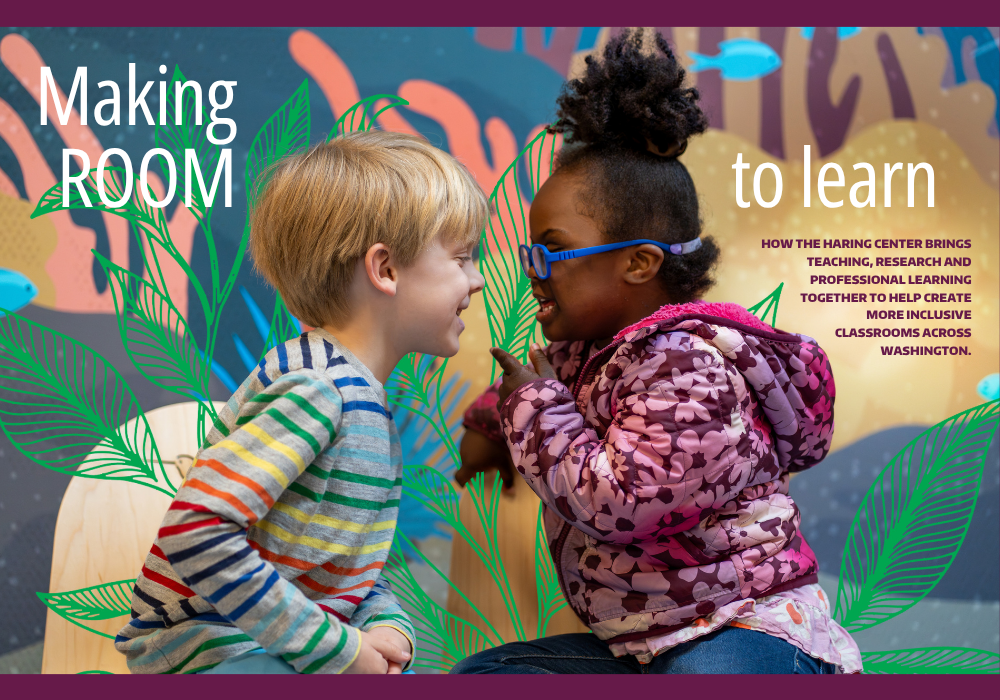
How the Haring Center brings teaching, research and professional learning together to help create more inclusive classrooms across Washington.
Here’s a preview of a story that will appear in the upcoming UW College of Education Advancing Educational Justice magazine, themed "Grow the Good." The Haring Center embodies that idea: growing good by nurturing inclusive practices, growing educators and researchers, and creating the conditions for what we learn together to take root in communities across Washington.
Before Amelia Maass ('25, MEd) became a preschool teacher, she was a child in the halls of the Haring Center. Her mother, a speech-language pathologist, has worked at the Experimental Education Unit (EEU) for 20 years. Maass grew up visiting the classrooms, then volunteering there through middle and high school, and later working summers at the center through college.
Today, Maass teaches preschool in Seattle Public Schools, in a classroom modeled on the EEU. Maass's story reflects how the Haring Center works.
At its center is the EEU, an inclusive school where children with and without disabilities learn together from infancy through kindergarten. Around those classrooms is a larger network of educators, researchers, families and graduate students who learn from one another, test new approaches and carry what they learn into new settings.
Professional learning teams work with schools, childcare providers and districts across Washington to adapt those ideas to their own communities. Researchers partner with children, families and educators to study practices that improve learning and belonging. Graduate student assistants work alongside children, teachers and researchers, gaining experience they can carry into their own classrooms and careers.
Maass is one of hundreds of educators, researchers and leaders who have moved through the Haring Center. Her story, and those of four other alumni, show how ideas developed in one school can travel into classrooms, professional learning programs and schools across Washington.
Learning together
At the EEU, years spent alongside children with a wide range of abilities helped make certain supports feel natural to Maass. Her current classroom brings together general education students and students with Individualized Education Programs (IEPs), co-taught by a general educator and a special educator. But it doesn’t have the additional support the EEU provides through UW volunteers and student workers.
Her team has fewer adults supporting a larger group of children across a full school day.
"It's harder to accommodate more of those needs," she says, "and I think that kind of dictates how inclusive it really can be."
What Maass experienced at the EEU follows her into her own classroom. For Bayley Maynard ('23, MEd), it shaped how she works with colleagues.
Maynard remembers having an IEP herself in high school, a personal connection to many of the students she now teaches at Nathan Hale High School. At the EEU, she learned to work closely with everyone involved in supporting a student. Talking with every specialist, teacher and assistant was simply part of the process.
She continues that practice now, inviting every teacher and assistant to meetings. Her coworkers noticed, because it was different from what they were used to. Her school is also expanding co-teaching and providing more support within general education classrooms, reflecting the inclusive practices Maynard experienced at the EEU.
Maynard has seen both the promise of this approach and the challenges schools face in sustaining it. Meaningful inclusion requires time for collaboration, manageable class sizes and enough trained educators to meet a wide range of student needs. When those resources are limited, even committed school teams must make difficult decisions about how to provide support.
Her experience reinforces an important lesson from the Haring Center that inclusion is not simply about placing students in the same classroom. It requires the people, structures and resources that allow every student to participate and belong.
Teaching the teachers
Some graduates teach children. Others teach teachers.
Julie Lockhart ('14, MEd) started at the EEU as an hourly assistant during her freshman year, in 2008. She stayed through college and grad school, spent eight years as a lead teacher, then moved to the Professional Development team in 2021. One week she's coaching a Head Start classroom; the next, training staff at a home daycare across the state.
As the Partner Manager of Professional Development at the Haring Center, Lockhart’s work reaches tens of thousands of educators and education professionals each year. Through partnerships with schools, districts, early learning programs and state agencies, the team helps educators adapt evidence-based inclusive practices to the realities of their own communities.
She trains in English and Spanish, and families have started sharing her materials with programs she's never visited, which is part of why the team now offers resources in Vietnamese and Chinese too.
What she's noticed lately: more children are entering early learning with complex needs, while the field keeps losing staff faster than it can train them.
"There's a lot of high turnover in early learning," she says, "which is tricky when you're coaching, because you're kind of starting from scratch when new staff come on board."
The flow doesn't only move outward. Questions from classrooms can become research, and that research can return as tools families and educators can use.
Katy Bateman (‘17, PhD) turned down other job offers to come back to Seattle. She'd been a master's student, then a doctoral researcher working with Ilene Schwartz, former Director of the Haring Center, and a postdoctoral researcher. Now she's a research scientist and project director studying how to support children with challenging behavior and the families raising them.
“It gave me such great, different perspectives,” the parent shared. “I am so grateful to have been part of something so beneficial to parents like me.”
Bateman says she kept returning because nowhere else had researchers, teachers and families working so closely together.
One project she's working on, Project ECHO for parents and caregivers of children with disabilities, is a remote parent program connecting families across Washington who may not otherwise have easy access to behavioral services for their child. It offers information, support and connection with other families navigating similar experiences.
For one participant, the experience offered more than information. It provided a community of people who understood what their family was navigating.
“It gave me such great, different perspectives,” the parent shared. “I am so grateful to have been part of something so beneficial to parents like me.”
It’s one example of the Haring Center’s model moving in both directions: families help shape the questions researchers pursue, and research returns to families as practical support they can use.
The long game
For some Haring Center alumni, the work extends beyond individual classrooms. It becomes a question of how systems must change.
RinaMarie Leon Guerrero (‘’06, PhD) almost took a different job. Looking for work-study as an undergraduate, she chose a position at the EEU over a data-collection job, and stayed: first as a paraeducator, then a graduate teaching assistant, a lead teacher, and later through a series of federal and state research grants.
Her connection to the work went back further than that, to a family member with a disability who wasn't educated alongside other children growing up.
Today, through the UW Demonstration Sites , a collaboration with OSPI and the Inclusionary Practices Technical Assistance Network (IPTN). She serves as the UW Demonstration Sites project lead, connecting her state-level work with the classrooms and educators at the center.
The demonstration sites mission is simple yet powerful: to empower schools to build inclusive learning environments where every student belongs and thrives. Even as more students with disabilities are learning alongside their peers in general education settings, those with the most significant disabilities remain the most likely to be educated in segregated settings, apart from their same aged peers . The disparity is even more striking for black students receiving special education services. An improving average can still leave some students waiting for the same opportunities as everyone else.
"There is no success too small," she says.
Through the IPTN, Haring Center staff partner with school teams to examine their current practices, participate in professional learning and coaching, and visit inclusive demonstration site schools and districts. The goal is not to replicate a single classroom or school model everywhere, but to help each school build an approach that works for its own community.
Back in Seattle, Maass is still in the classroom — the same kind of room she once wandered through as a child at the EEU, now one she runs herself. The children she teaches may never know about the research, professional learning or people who helped shape the classroom around them. They will simply experience the classroom: who is there, how they learn together, and how the adults around them make space for their differences.
Maass's path from the EEU to her own classroom is one version of how the Haring Center's work moves forward. For others, it leads to teacher training, research, family support or work at the state level. The settings change, but the work stays connected to the same question: How do we make sure children can learn together?
